The value proposition is one of the most important concepts in strategic management, as it represents the set of benefits a company offers its customers to meet their expectations, solve their problems, or satisfy their desires in a way that surpasses the competition. In other words, it is the value promise a company makes to the market, explaining why consumers should choose its products or services over other available alternatives.
An effective value proposition goes beyond a simple description of a product or service’s features. It highlights attributes valued by the customer—such as quality, innovation, convenience, cost-effectiveness, reliability, customer service, customization, sustainability, or any other relevant competitive differentiator. Thus, the value proposition connects the company’s capabilities with the expectations and needs of its target audience.
In today’s competitive environment, characterized by rapid technological transformation and high consumer expectations, having a clear and consistent value proposition has become essential for business survival and growth. Companies that can clearly and concisely communicate the benefits they offer tend to foster greater customer loyalty, strengthen their brand, and expand their market share.
According to Prahalad and Hamel, the process of creating value for a company’s various stakeholders consists of three stages, as shown in Figure 1.
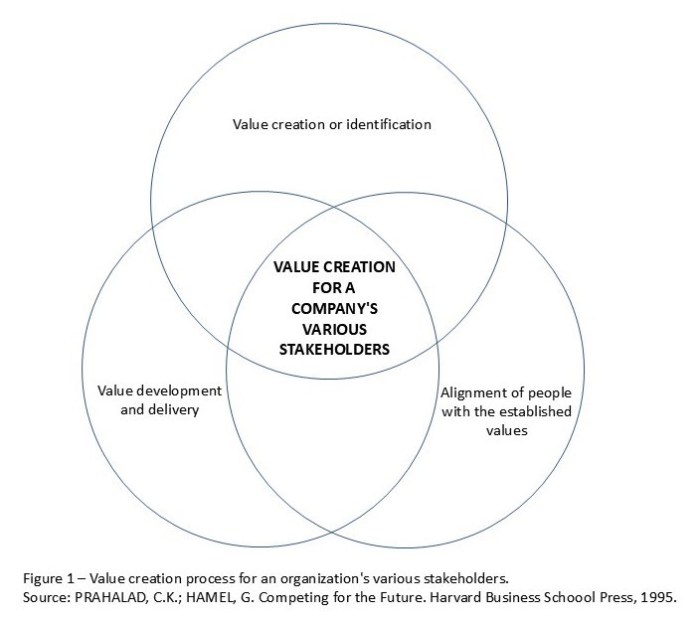
Developing a value proposition begins with understanding the customer. The company must identify its target audience and grasp their needs, preferences, expectations, pain points, and consumption behaviors. This insight can be gained through market research, interviews, data analysis, observation of consumer behavior, and monitoring industry trends.
Once the customer is understood, the company must identify the problems they face and the opportunities to develop distinctive solutions. At this stage, it is crucial to analyze which needs are not yet fully met by competitors and which attributes can generate a higher perception of value.
The next step involves assessing the organization’s internal resources, competencies, and capabilities. The company must identify its strengths, available technologies, specialized knowledge, efficient processes, and other competencies that can be transformed into competitive advantages. In doing so, it ensures that its value proposition is not only attractive to the customer but also viable and sustainable in the long term.
Another important aspect is analyzing the competition. Understanding the value propositions offered by competing companies makes it possible to identify opportunities for differentiation. The organization should seek unique or superior attributes that set it apart in the market, avoiding competition based solely on price.
An effective value proposition must clearly answer a few fundamental questions: Who is the customer? What problem will be solved? What benefits will be delivered? Why is this solution better than existing alternatives? The answers to these questions help craft a clear, concise, and compelling message for the market.
Developing a value proposition also involves defining the functional, emotional, and social benefits provided to the consumer. Functional benefits relate to the performance of the product or service. Emotional benefits refer to positive feelings generated during the consumption experience, such as trust, security, and satisfaction. Social benefits, meanwhile, concern the recognition, status, or image conveyed by using the brand.
A widely used tool in this process is the Value Proposition Canvas, which helps companies align their products and services with customer needs. This model allows for mapping the tasks consumers perform, their pain points, and their expected gains, as well as how the company’s solutions can eliminate difficulties or generate additional benefits.
Once developed, the value proposition must be validated with the market. The company can conduct customer tests, gather feedback, develop prototypes, or launch pilot versions of products and services. This process allows for adjustments prior to large-scale implementation, thereby reducing risks and increasing the likelihood of success.
Communication also plays a crucial role. An excellent value proposition loses its effectiveness if it is not clearly communicated to the public. Therefore, the company should employ marketing, advertising, relationship management, and digital communication strategies that highlight its competitive advantages and strengthen its image among consumers.
Furthermore, a value proposition should not be viewed as static. Changes in consumer behavior, technological advancements, and shifts in the competitive landscape necessitate periodic reviews. Innovative companies continuously monitor the market and adapt their value propositions to maintain their competitiveness.
World-renowned companies have achieved success precisely by developing credible and consistent value propositions. Some stand out for technological innovation, others for personalized service, convenience, competitive pricing, or sustainability. Regardless of the strategy adopted, they all succeed in delivering benefits that customers perceive as relevant.
When well-developed, a value proposition helps increase customer satisfaction and loyalty, strengthen brand reputation, boost competitiveness, drive sales growth, and generate a sustainable competitive advantage. Furthermore, it guides the company’s strategic decisions, aligning products, services, processes, and investments with market needs.
It can be concluded that a value proposition represents much more than a simple commercial promise. It constitutes a strategic element that guides the company’s actions and directly influences its ability to develop, deliver, and capture value. Its development requires knowledge of the customer, analysis of the competitive environment, identification of internal competencies, continuous innovation, and efficient communication. Organizations that invest in building solid value propositions are able to establish lasting relationships with their customers and achieve better results in increasingly dynamic and competitive markets.
(This article was developed with the aid of AI)


