Customer Experience (CX) encompasses the set of perceptions, emotions, and impressions formed by the customer in all interactions with an organization.
The concept of CX involves the entire customer journey, from the first contact with the brand to after-sales service. More than offering quality products and services, companies need to provide favorable, memorable, and consistent experiences. Customers today are more informed, connected, and demanding, valuing companies that understand their needs and expectations. In this context, customer experience has become a strategic competitive differentiator. Companies that invest in CX can strengthen relationships, increase loyalty, and generate a competitive advantage in the market.
Customer experience involves planning, monitoring, and continuously improving all interactions with the consumer. This management involves organizational culture, people, processes, and technology oriented towards the customer. The main objective is to deliver value in every contact opportunity for the customer journey. A positive experience directly influences customer satisfaction, trust, and consequently, loyalty. Customer-centric companies understand that each interaction impacts the perception of the brand. Therefore, CX management requires strategic alignment between all areas of the organization.
Customer service is one of the main elements of the experience. Agile, humanized, and efficient service contributes significantly to customer satisfaction. In addition, clear and transparent communication strengthens the relationship of trust between company and customer. Another important aspect is the personalization of the experience. Consumers expect solutions tailored to their specific preferences and needs. The use of data and technologies makes it possible to better understand the behavior of each customer. Digital tools help companies anticipate expectations and demands to offer more relevant experiences.
Digital transformation has amplified the importance of customer experience in both physical and virtual environments. Currently, consumers use multiple interaction channels, requiring integration and consistency across them. This model is known as omnichannel experience. In an omnichannel strategy, the customer should receive the same quality standard across all channels used.
Experience management also involves mapping the customer journey. Mapping allows for the identification of needs, difficulties, and opportunities for improvement. With this, companies can eliminate flaws and optimize processes. Actively listening to the customer is another key factor for the success of CX management. Satisfaction surveys, evaluations, and feedback provide essential information for strategic decisions. Indicators such as Net Promoter Score (NPS), Customer Satisfaction Score (CSAT), and Customer Effort Score (CES) are widely used to measure customer experience. These metrics help monitor performance and identify opportunities for improvement.
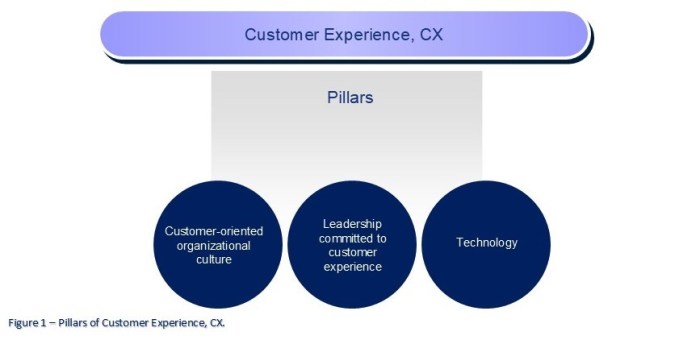
Customer-oriented organizational culture is one of the fundamental pillars of CX. The entire organization must understand that the customer is at the center of business decisions and actions. Employees play an essential role in building positive experiences. Engaged and empowered employees tend to offer better service and better solutions. Another important pillar is leadership committed to customer experience. Leaders need to encourage practices focused on empathy, innovation, and continuous improvement. Technology is also considered a strategic pillar in experience management. CRM systems, artificial intelligence, and automation contribute to greater efficiency and personalization. However, technology should support the humanization of relationships and not replace human contact.
The main pillars of customer experience can be seen in Figure 1.
Trust is an indispensable element in building positive experiences. Ethical and transparent companies strengthen their reputation and credibility with consumers. Agility in problem-solving also directly impacts customer perception. Consumers value companies that resolve demand quickly and efficiently.
Continuous innovation is necessary to keep up with changes in market behavior.
Customer expectations are constantly evolving, requiring organizations to adapt. Innovative companies manage to positively surprise their consumers. Customer experience should be understood as a continuous and strategic process. It is not just about providing good service, but about developing lasting emotional connections. When customers perceive value in the experience, the likelihood of repeat purchases and brand recommendations increases. Satisfied customers become spontaneous promoters of the company. This contributes to strengthening the institutional image and the sustainable growth of the business. Efficient management of customer experience generates financial and competitive benefits. Furthermore, it promotes greater customer loyalty and reduces costs related to complaints and rework.
In the current scenario, CX has ceased to be a differentiator and has become a strategic necessity. Companies that prioritize customer experience gain greater relevance in the market. The integration between strategy, processes, people, and technology strengthens excellence in CX. Thus, customer experience becomes an essential element for organizational success.
Customer-centric companies can build stronger, more human, and sustainable relationships. Investing in CX means investing in value, innovation, and competitiveness. In this way, customer experience management consolidates itself as one of the main factors for growth and differentiation of companies.


