Strategic vision is the ability to clearly project a plausible, desired future that is firmly aligned with long-term objectives, taking into consideration environmental opportunities and threats. It is a central element in strategic planning, working to guide decisions, investments, and the allocation of resources. Rather than an attempt to predict the future, strategic vision involves devising possible scenarios and defining the path the organization must follow to achieve a sustainable competitive position.
The concept is related to anticipation and alignment: The manager with a strategic vision understands that environments and markets are dynamic; that technological, regulatory, demographic, economic and behavioral changes can quickly modify operational circumstances; and that the company must adapt while remaining committed to its purpose. Thus, a strategic vision combines intuition, rational analysis, creativity, and sensitivity to accurately interpret the signals of the environment.
According to Chiavenato and Sapiro (2023), strategic vision can be viewed from four perspectives, four ways of understanding the world: systemic vision, peripheral vision, predictive vision, and insight and intuition.
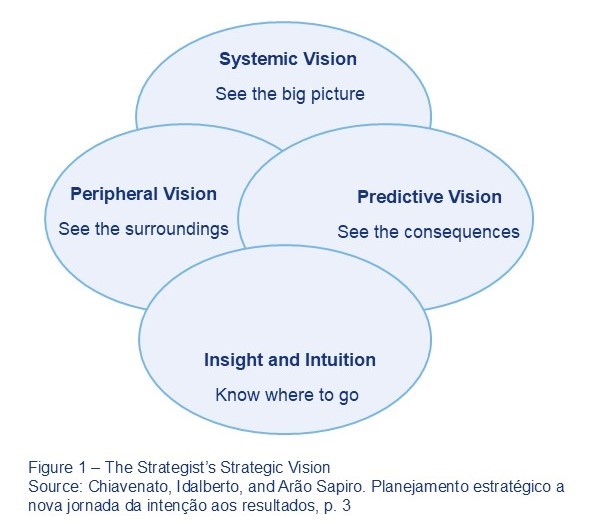
Its importance to the company is broad: First, the strategic vision establishes a guide for decisions at all levels of the company, focusing efforts and ensuring consistency in actions. It contributes to the achievement of competitive advantage by helping you to identify trends before competitors do, and position yourself proactively. Its clear strategic intention and purpose foster motivation and commitment of teams.
Another relevant aspect is that strategic vision aids in the efficient allocation of resources: In an environment of budget constraints and pressure for results, discerning where to invest and where not to is of paramount importance. In addition, it mitigates risk by helping you anticipate changes and prepare appropriate responses. Companies that lack this vision will tend to act in a reactive manner, increasing vulnerability to crises and loss of market share.
Developing and sustaining a strategic vision come with significant challenges. These include:
- The uncertainty of the business environment, due to factors like political and technological disruptions and changes in consumer behavior, make forecasting complex.
- Resistance to change from within the organization itself, making the implementation of the vision difficult.
- Transforming the strategic vision into concrete actions — many companies have well-formulated vision statements but fail to decompose the vision into goals, indicators, and operational processes.
- The lack of clear and consistent internal communication often thwarts the strong alignment of leaders and their teams.
- Focusing on the short term in response to pressure for immediate results can lead managers to prioritize immediate gains at the expense of long-term objectives, thereby weakening the execution of the strategic vision.
- Keeping the vision up to date requires constant monitoring of the environment and the flexibility to make timely adjustments, something that not all organizations accomplish.
In conclusion, strategic vision is a fundamental pillar for company competitiveness and sustainability, providing clarity, direction, and unity to better navigate complex and unpredictable scenarios. For it to be effective it needs to be realistic, communicated effectively, translated into measurable actions, and periodically reviewed. More than a formal document, the strategic vision should be a living, breathing element in the organizational culture, inspiring leaders and teams to pursue, in a consistent and adaptable way, their vision of the future.


 Professor Annibal