Welcome back to Management Tips! Today we return to the theme of strategic agility, which we addressed previously in the post “Agile Strategy: In Search of Strategic Agility” (March 2020).
Strategic agility, simply, is companies’ ability to see changes in the business and business environment in which they operate. Strategic agility consists of the ability to stay competitive, identifying and exploiting opportunities, and identifying and mitigating potential threats, or even preventing them from materializing. The development of strategic agility gives leaders the competence to recognize positive and negative changes in the environment / market and to act quickly, evaluating new ideas when called for. Strategic agility is defined as “the ability to remain flexible in facing new developments, to continuously adjust the company’s strategic direction, and to develop new ways to create value” (Weber and Tarba, 2014).
In other words, strategic agility is related to a company’s ability to respond quickly and efficiently in order to drive change, while maintaining flexibility and focus. It is challenging and demands insight and a lot of work and effort on the part of the company and its leaders. The continuous change in the dynamics of markets and new technologies have directed part of the strategic efforts of companies towards diversification, i.e., exploring new opportunities beyond the core business.
In the book The Alchemy of Growth, published in 1999, Mehrdad Baghai, Stephen Coley, and David White presented strategic agility through the “Three Horizons Model.” The authors described the approaches that helped their corporate clients around the world speed up the pace. Companies should simultaneously focus on the three “horizons” critical to growth: 1) The company’s current business, or core business; 2) Emerging, promising, and rapidly developing businesses; and 3) The ideas that will ensure future results, i.e., new businesses.
The Three Horizons of Growth Model proposes dividing business expansion initiatives into three categories (“horizons”). On a cartesian plane (see Figure 1) the horizontal axis represents the time required for the execution of initiatives, encompassing short, medium and long terms; the vertical axis represents potential returns.
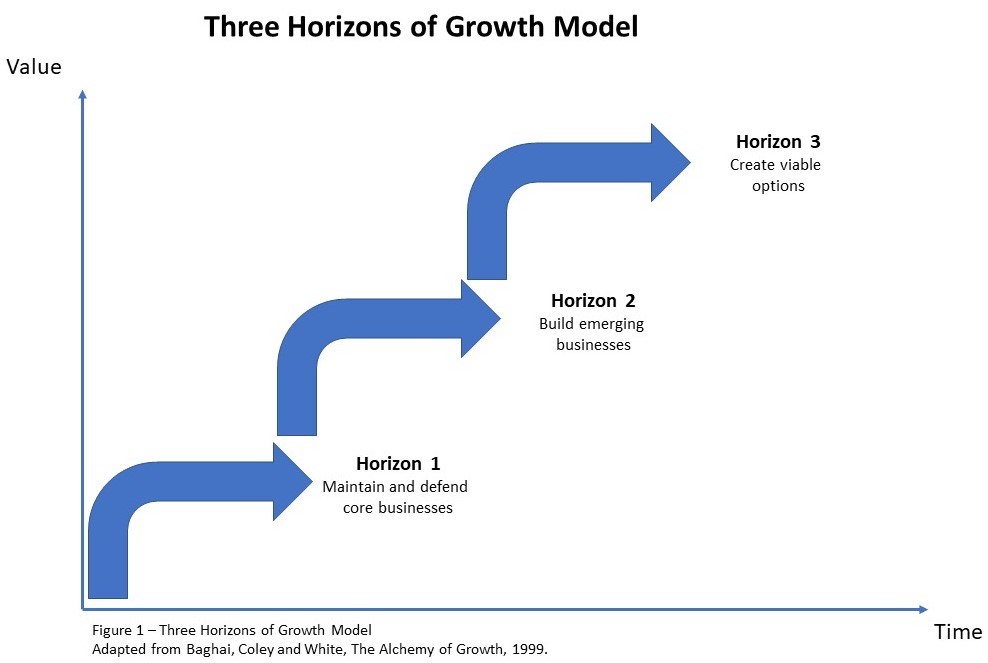
The three horizons can be best explained as follows:
Horizon 1 – Maintain and defend the core business – Activities focused on core businesses and the current value proposition of the company, with the expectation of results in the short term. Ideas that generate continuous innovation of the current business model and principal resources in the short term.
Horizon 2 – Build emerging businesses – Exploration of emerging opportunities, expanding the business model and using the company’s competencies to penetrate new markets, generating results in the medium term. Ideas that expand the existing business model and the principal resources of a company for new customers.
Horizon 3 – Seed genuinely new and viable options – Development of new competencies and business strategies to generate disruptive innovations with long-term profitability expectation. Development of new resources and new businesses to exploit disruptive opportunities.
Steve Blank, in McKinsey’s “Three Horizons Model Defined Innovation for Years. Here’s Why It No Longer Applies,” published in Harvard Business Review in February 2019, draws attention to the fact that companies that structure themselves to explore Horizons 2 and 3 in the medium and long terms only can be negatively impacted, as there will be players in the chain, insurgents or incumbents, adopting exponential technologies and operating with good business models. Each horizon requires different focus, management, tools and objectives. McKinsey suggested that to remain competitive in the long run, a company must allocate its research and development resources across all three horizons.
The Three Horizons Model continues to be very useful as a guideline in prioritizing innovation initiatives. The trap of the Three Horizons Model is not to recognize that these days many disruptions can be implemented very quickly by redirecting existing Horizon 1 technologies into new business models — and that deployment speed is disruptive and asymmetric in itself (Blank, 2019).


 Professor Annibal