The Innovation Ambition Matrix, presented in Harvard Business Review in the May 2012 article “Managing Your Innovation Portfolio” by Bansi Nagji and Geoff Tuff, is an established model that helps companies manage their innovation portfolio, evaluating and deciding how to finance different development and growth initiatives. The Innovation Ambition Matrix is a tool that allows companies to identify strategy execution alternatives for where to bet and how to win.
The Matrix identifies three levels of innovation, ranging from incremental (“core”) to disruptive (“transformational”) through expansion into the adjacencies, as illustrated in Figure 1.
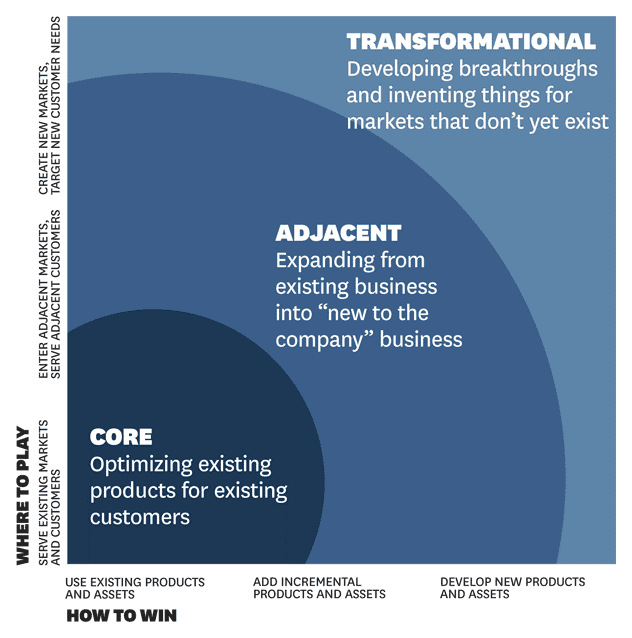
Figure 1: Innovation Ambition Matrix, by Bansi Nagji and Geoff Tuff (https://bit.ly/3QGdTAP)
At the “core” level in the lower left of the Matrix are the main innovation initiatives, i.e., the efforts to make incremental changes in existing products/services.
On the second level, in the center of the Matrix, are the initiatives that are a little more daring. These are the ideas that the authors identify as “adjacent initiatives.” This is where a company enters a new market with the activities it already performs well, e.g., modifying an existing product and selling it to a new customer segment. This extends the current resources and capabilities of companies to serve customers in a different way.
The third level in the upper right of the Matrix are the “transformative initiatives” where real watersheds are found, where a company seeks a whole new market to meet the needs of new customers. For these ideas to flourish, companies need to be willing to invest in the development of new assets and new markets. If appropriate, this initiative can add a whole new business. Think of the example of AWS.
The authors recommend the 70-20-10 rule for balance between innovation initiatives. Research (HBR, May 2012) showed that companies allocating 70% of their activities in core, 20% in adjacent, and 10% in transformational achieve superior competitive performance when compared to the competition.
The Matrix helps companies understand the importance of aligning innovation efforts, rather than just looking at each project in isolation. Sometimes it’s the first opportunity a leadership team has to visualize the real ambitions of their project portfolio and compare that to the guidance of their strategy.
According to the authors, for many companies innovation will continue to be a set of intense but uncoordinated activities. For many executives it will continue to be a source of frustration. For visionary executives, it represents the most stimulating and important challenge. By figuring out how to manage the innovation portfolio as an integrated system within the goals of the total portfolio, they can harness their energy by making it a reliable driver of development and growth for the long run.


 Professor Annibal