When it comes to developing and implementing the strategy, one of the main business challenges is tracking results; in other words, managing performance. Using OKRs can assist you with this.
Objectives and key results, or simply OKRs, have become one of the most widely used models by teams that want to plan and measure the outcome of their work.
In this article we will explain what OKRs are and how they can be used to manage company performance.
OKRs are an effective performance management methodology for setting goals and for leadership to communicate what the company wants to accomplish and what milestones it will need to achieve to get results. The goal of using OKR is to promote employee engagement and raise productivity rates. OKRs are used by some of the world’s leading companies to define and implement their strategies. It is a methodology used by teams to set challenging goals by proposing measurable results. OKRs are how the company monitors business performance, creates alignment, and encourages engagement around measurable goals.
As illustrated in Figure 1, the OKR consists of an Objective and a set of Key Results.
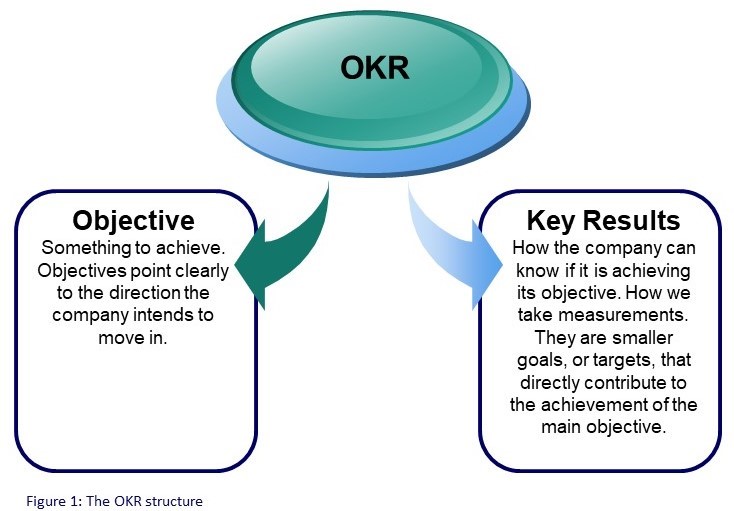
OKRs are usually written with an overall objective at the top, broken down into sub-objectives if needed, with 3 or 4 supporting key results. They can also be written as an active, first-person declaration, e.g., “I will [objective], as measured by [key results]”.
Let’s say that the company wants to achieve the strategic objective “Satisfied Customer” from their strategic map. This objective can be broken down into three key results:
- KR 1: Increase the number of active customers from 6000 to 8000
- KR 2: Increase the customer loyalty/retention rate by 10%
- KR 3: Increase the Net Promoter Score (NPS) from 75 to 80
The OKR methodology is relatively simple and if used correctly can contribute to the generation of important results for the company. Good OKRs will provide the company with a tool for the development of high-performance management for all business objectives.
Finally, keep in mind that successfully deploying OKRs is fundamental to the commitment of key leaders. Make sure, too, to take into account the context and culture of the company.
Ready to start using OKRs?
Read more about OKRs in Jeff Gothelf’s article “Use OKRs to Set Goals for Teams, Not Individuals,” published in the December 2020 issue of Harvard Business Review.[1]
[1] Available at https://hbr.org/2020/12/use-okrs-to-set-goals-for-teams-not-individuals.


 Professor Annibal